Note
Go to the end to download the full example code.
Sentinel-2 snow index, and the two catalogs side by side#
Sentinel-2 L2A comes from Planetary Computer by default and from Earth Search
with source="earth-search". Both are credential-free; the loader puts
every scene on the pre-2022 baseline, so the two agree pixel for pixel.
import matplotlib.pyplot as plt
import numpy as np

import easysnowdata as esd

aoi = (-121.80, 46.82, -121.72, 46.88)  # the Nisqually glacier side of Rainier
Search first: the result is a GeoDataFrame you can filter before loading.
items = esd.optical.sentinel2.search(aoi, "2023-08-01/2023-08-12", cloud_cover=40)
print(items[["datetime", "eo:cloud_cover", "collection"]].head())
                                                                           datetime  ...      collection
S2B_MSIL2A_20230808T190919_R056_T10TES_20241022... 2023-08-08 19:09:19.024000+00:00  ...  sentinel-2-l2a
S2B_MSIL2A_20230808T190919_R056_T10TES_20230809... 2023-08-08 19:09:19.024000+00:00  ...  sentinel-2-l2a
S2A_MSIL2A_20230803T190921_R056_T10TET_20241029... 2023-08-03 19:09:21.024000+00:00  ...  sentinel-2-l2a
S2A_MSIL2A_20230803T190921_R056_T10TET_20230804... 2023-08-03 19:09:21.024000+00:00  ...  sentinel-2-l2a
S2A_MSIL2A_20230803T190921_R056_T10TES_20241029... 2023-08-03 19:09:21.024000+00:00  ...  sentinel-2-l2a

[5 rows x 3 columns]
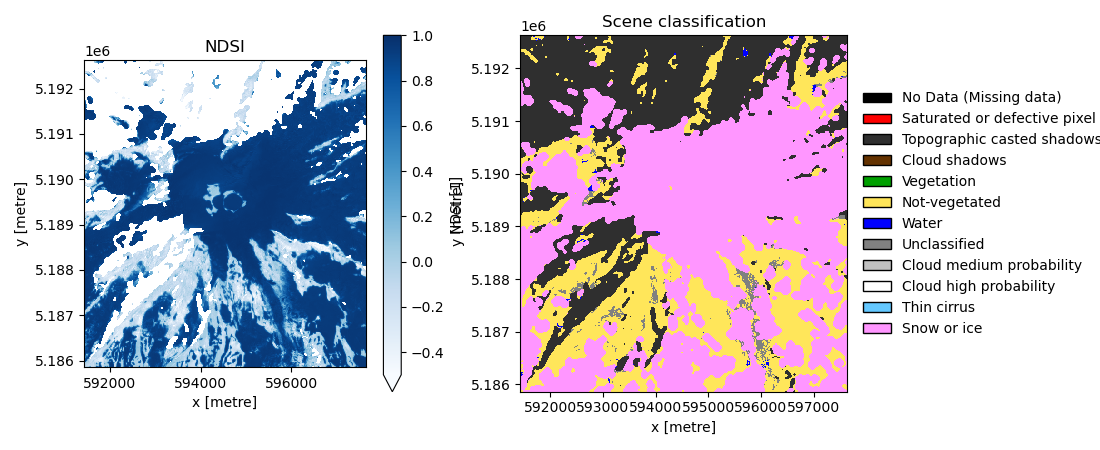
Load the clearest scene, masked with the default SCL classes, and take NDSI.
clearest = items.sort_values("eo:cloud_cover").iloc[:1]
s2 = esd.optical.sentinel2.load(
    aoi, items=clearest, bands=["green", "swir16", "red", "scl"], mask="scl-default"
)
ndsi = esd.processing.ndsi(s2).isel(time=0)

fig, axes = plt.subplots(1, 2, figsize=(11, 4.5))
ndsi.plot.imshow(ax=axes[0], cmap="Blues", vmin=-0.5, vmax=1.0)
axes[0].set_title("NDSI")
esd.plotting.categorical(
    s2["scl"].isel(time=0), ax=axes[1], title="Scene classification"
)
for ax in axes:
    ax.set_aspect("equal")
fig.tight_layout()
The same day from both catalogs. Earth Search’s sentinel-2-l2a pixels
already carry the baseline correction and Planetary Computer’s do not, so
the loader reads each catalog’s metadata rather than applying one date rule
everywhere; the medians below agree to well under a percent of reflectance.
window = dict(bands=["red"], resolution=60, crs="EPSG:32610")
pc = esd.optical.sentinel2.load(aoi, "2023-08-10/2023-08-11", **window)
es = esd.optical.sentinel2.load(
    aoi, "2023-08-10/2023-08-11", source="earth-search", **window
)
for name, ds in (("planetary-computer", pc), ("earth-search", es)):
    median = float(np.nanmedian(ds["red"].isel(time=0).compute().values))
    print(f"{name}: median red reflectance {median:.4f}")
planetary-computer: median red reflectance 0.3187
earth-search: median red reflectance 0.3131
Total running time of the script: (0 minutes 6.729 seconds)