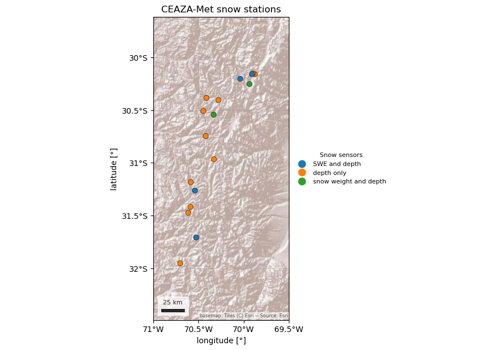
easysnowdata.stations.clients.CEAZAClient#
- class easysnowdata.stations.clients.CEAZAClient(user: str | None = None, base_url: str = 'https://www.ceazamet.cl/ws/pop_ws.php', timeout: int = 120, max_retries: int = 3, backoff: int = 4, session: Session | None = None)[source]#
Bases:
objectClient for the CEAZA-Met web service (Coquimbo region, Chile).
No credentials are needed; see the module docstring for the terms of use (registration by e-mail, attribution).
- Parameters:
user (
str, optional) – The e-mail address registered with CEAZA-Met, sent asuser=. Without it the service applies its anonymous limits.base_url (
str) – Web-service URL.timeout (
int) – HTTP settings for the shared retry loop.max_retries (
int) – HTTP settings for the shared retry loop.backoff (
int) – HTTP settings for the shared retry loop.session (
requests.Session, optional) – Pre-configured session.
- get_all_stations(active_only: bool = False, bbox: tuple[float, float, float, float] | None = None, snow_only: bool = True) list[dict][source]#
CEAZA-Met stations; by default only those with a snow sensor.
- Parameters:
- Returns:
list[dict]–station_id(e_cod),name,latitude,longitude,elevation_m,status,network("CEAZA-Met"),owner(e_ownercode),operator(fromOWNERS, else the code),province_code,first_reading/last_reading(as served) andbegin_date/end_date(their dates),measurement_method,has_swe,has_snwd,has_temp,has_precip,is_snow_station,snow_sensors(s_codlist),snow_variables(tm_codlist),n_sensors,served_sensorsandstation_url.- Raises:
CEAZAError – If the service cannot be reached or returns nothing.
- get_sensors(station_id: str) list[dict][source]#
Every sensor of a station, as the network-wide sensor list gives it.
- Returns:
list[dict]–station_id,sensor(s_cod),variable(tm_cod),name(tf_nombre),units(um_notacion),height_m,begin_date,end_date.
- get_metadata(station_id: str) dict[source]#
Station metadata plus
data_variablesandsensors.- Parameters:
station_id (
str) –e_cod(e.g."TPF","TASC"); any station, snow or not.- Returns:
dict– The station dict plusdata_variables(one entry per sensor this client serves:name(tm_cod),sensor,native_name,type,units(native),output_units,height_m,begin_date,end_date,intervals) andsensors(every sensor, seeget_sensors()).- Raises:
CEAZAError – If the station is not in the station list.
- get_series(sensor: str, begin_date: str | date, end_date: str | date, interval: str = 'daily') dict[source]#
Raw
GetSerieSensorJSON for one sensor and one window.- Returns:
dict– The service’s payload (e_cod,s_cod,tf_nombre,um_notacion,serie, …).- Raises:
CEAZAError – On an unsupported interval, an unknown sensor or a service error.
- get_data(station_ids: list[str] | str | None = None, variables: list[str] | str | None = None, bbox: tuple[float, float, float, float] | None = None, begin_date: str | date | None = None, end_date: str | date | None = None, interval: str = 'daily', include_flags: bool = False, sensors: list[str] | str | None = None) list[dict][source]#
Station data as flat records, one per sensor and interval with data.
- Parameters:
station_ids (
list[str]orstrorNone) –e_codcode(s). Required unlessbboxis given.variables (
list[str]orstrorNone) –tm_codcodes ("ani_cm","ae_mm","ae_cm","pnkg","ta_c","pp_mm") or types ("snwd","swe","temp","precip").None= the snow variables (snwd+swe).bbox (
tuple, optional) –(min_lon, min_lat, max_lon, max_lat); selects snow stations.begin_date (
strordate, optional) – InclusiveYYYY-MM-DDbounds (UTC−4 days). Default: each sensor’s first reading to today.end_date (
strordate, optional) – InclusiveYYYY-MM-DDbounds (UTC−4 days). Default: each sensor’s first reading to today.interval (
str) –"daily"(default) or"hourly".include_flags (
bool) – Addflag(“complete” / “partial”, seeDATA_FLAGS).sensors (
list[str]orstr, optional) – Keep only these sensor codes (s_cod), e.g."TPFSWE_K".
- Returns:
list[dict]–{station_id, date, variable, type, value, units, interval, sensor, value_min, value_max, data_pct}(+datetimefor hourly,flag).valueis the interval mean (precipitation: the total) and isNoneoutside the plausibility bounds.- Raises:
ValueError – If neither
station_idsnorbboxis given.CEAZAError – On an unknown variable, station or sensor, an unsupported interval, or a service error.
Example
>>> client = CEAZAClient()
>>> recs = client.get_data(
...     "TASC", variables="snwd",
...     begin_date="2025-08-01", end_date="2025-08-31",
... )
>>> recs[0]["units"], recs[0]["sensor"]
('cm', 'TASCAN')