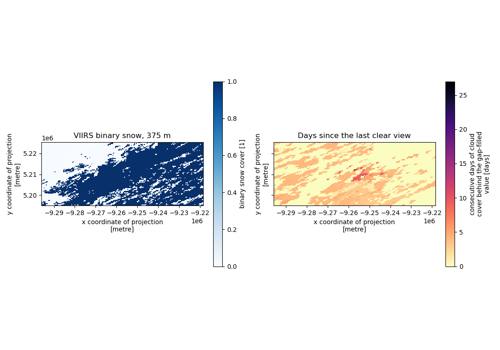
easysnowdata.snow.viirs.load#
- easysnowdata.snow.viirs.load(aoi: Any = None, time: Any = None, *, product: str = 'VJ110A1F', variables: str | Sequence[str] | None = None, source: str | None = None, granules: Any = None, mask: bool = False, chunks: Any = 'easysnowdata-default', **kwargs: Any) Dataset[source]#
Load VIIRS snow cover as a lazy
xarray.Dataset(time,y,x).- Parameters:
aoi – The usual spatial and temporal inputs.
time – The usual spatial and temporal inputs.
product –
"VJ110A1F"(NOAA-20, cloud-gap-filled, default, from 2018-01-05),"VJ110A1", or the Suomi-NPP"VNP10A1F"/"VNP10A1"(from 2012-01-19; deliveries expected to stop 2026-11-02).variables – Data fields to read; the product’s main field by default. The others are
Cloud_Persistence,Basic_QAandAlgorithm_Bit_Flags_QA.mask –
TrueNaN-masks the sentinel values; the default keeps the raw byte with its CF flags, so(ndsi_da >= 40).where(ndsi_da <= 100)is the usual binary mask.